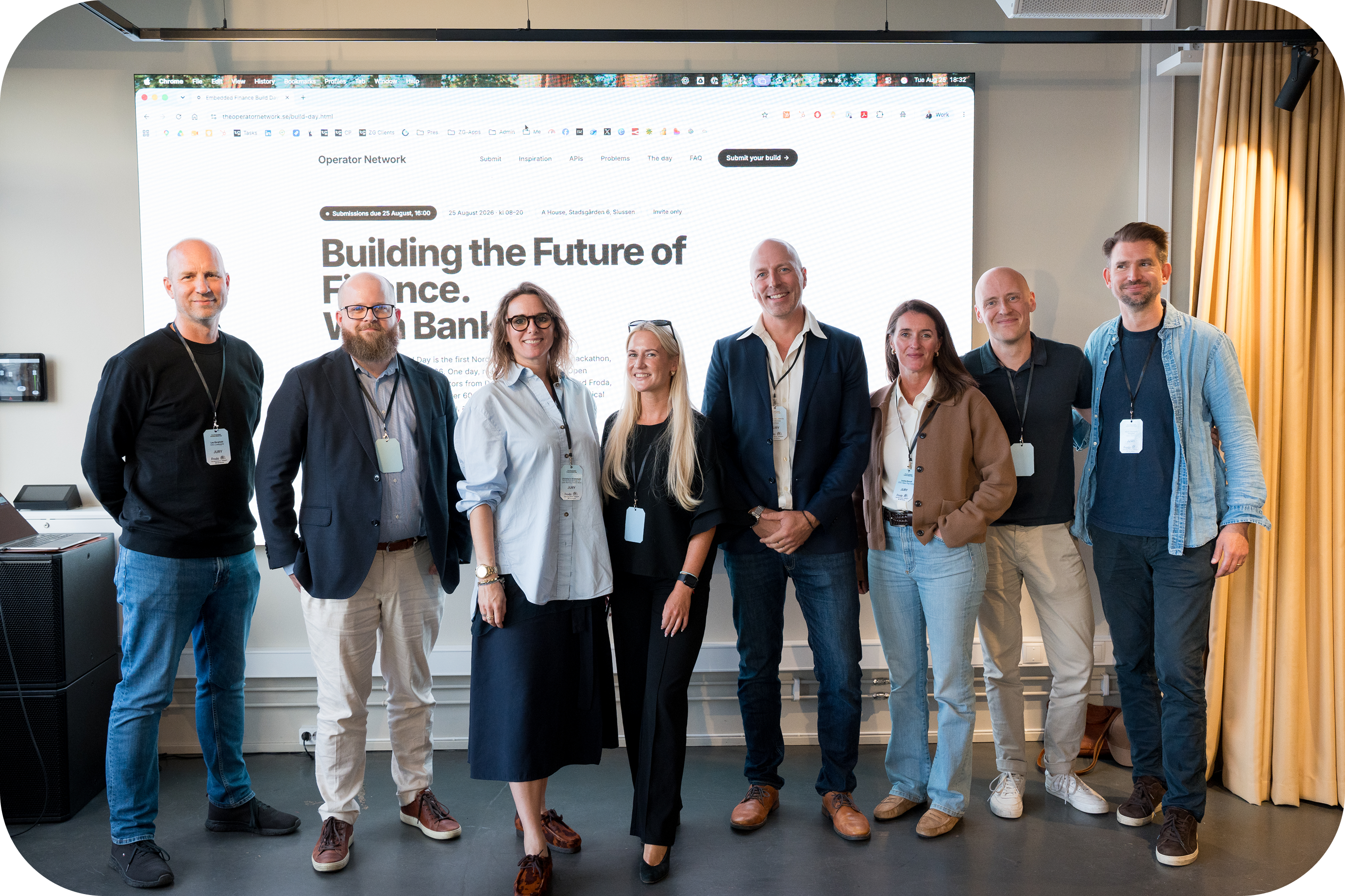
A case study of the Embedded Finance Build Day, a vendor-neutral one-day hackathon in Stockholm produced by Alexandra Studio with the Operator Network alongside Danske Bank, Froda, Worldline, Open Payments and Zwapgrid. For one partner it reached 142 organisations and 376 individuals organically with no advertising spend, drew 98 registrations and 72 approved attendees including co-founders, CTOs and Heads of Digital, produced 15 working prototypes built on the partner API, and added roughly 1.5 MSEK of potential pipeline. Seven of fifteen teams independently chose the same problem, giving unprompted product validation.
Growth System for B2B Fintech
Return on Investment, Case Studies
A Repeatable and Scalable Loop
The concept is pretty simple. Digital channels are exhausted. Now we have figured out an organic social media strategy that actaully uses your network and second-connections to reach the fintechs you can collaborate with. It goes like this: co-host, create social tagging organic content, meet in person, build thought leadership from it and repeat. It's actually simple but it takes work and a network. This is how we work with our clients.
One fintech hackathon produced:
142
organisations reached (approximately 80K SEK in ad reach, free)
0 kr
actually spent on advertising to reach them
15
stories about API infrastrucuture (about 400K SEK worth of content pipe)
Reach and account penetration.
Not impressions. Named organisations, with named people inside them, who can be followed up by a human the same week.
Fifteen target-account companies were reached organically without ever registering — SEB Embedded, Fortnox, Klarna, Insurely and others. Seniority in the room ran to co-founders, CTOs, Heads of Digital and Product Directors.
Total ROI reached 850%
Reach Without Ad Spend
Around 506 reactions and 80 comments across the day, carried by five partners, the jury and every team that built something. At Nordic financial-services rates, buying that same senior audience through LinkedIn would have been a significant media line. It cost nothing.
Pipeline You Can Name
Ten to fourteen new leads, each a named person at a named company. At the 20% conversion rate in-person events run at, that is two to three new clients and roughly 1.5 MSEK of potential deal value entering the pipeline from a single day.
Product Feedback You Cannot Buy
Fifteen teams, all of them using both APIs. Seven independently picked the same fraud problem without prompting. Three built the same missing primitive. Developers described the product as the layer that makes the underlying system irrelevant — the intended positioning, landing unprompted.
From a random act of marketing to a growth system
Run once, this was a great day and a real return. But a single event is a stand-alone spike, does not create sustained growth.
The same activity compounds when it becomes a system. Each event builds thought leadership, which generates curiosity, which opens collaborations with brand-relevant companies, which produces the next event from a higher starting point.
What we do for our clients:
Thought leadership
We are building brand in Fintech through idea sharing. Together we publish what captures banks and fintech's POV. A point of view, not a pitch.
Curiosity
The point of view reaches people, building a name for your company, giving brand-relevant companies a reason to reach out and collaborate.
Collaboration
You co-host with those companies with in-person events. Nothing builds trust faster than person-person contact time. Their audience becomes reachable, and the invitation carries both names.
Audience share / Developer Mind Share
The room, plus the content it produces, converts attention into named contacts and if your product is deeply technical we mix in developers, who have actually built on it.
Measured return, Rinse and Repeat
Every stage is counted against named accounts. The next cycle starts from a higher level, making the companies your collaborate a higher caliber, farther reach, deeper penetration.
What the numbers mean.
The reach figures are the ones people expect from a marketing report, and they are the least interesting part. 142 organisations is a good number, but what makes it useful is that every one of them is named, and 17 of them had more than one person engaged — which in a market where six to ten people have to agree is the difference between awareness and a buying committee warming up.
The second thing worth noticing is what was reached without being invited. Fifteen target accounts engaged with the day organically and never registered. Nobody paid to put the event in front of SEB Embedded or Klarna; they arrived because the people they trust were talking about it.
The output that would have been hardest to buy is the build itself. Forty-four people voluntarily pointed six hours of skilled engineering at one company's API and problem space. Getting that calibre of attention through a conventional commissioned sprint is expensive, slow, and produces work by people who were paid to care rather than people who chose to.
And it doubles as validation. When seven of fifteen teams pick the same problem unprompted, that is a market telling you where the pain is. When three build the same missing primitive in an afternoon, that is a roadmap item that arrives with its own evidence. No survey produces that.
FAQ
What was the Embedded Finance Build Day?
A one-day, industry-wide hackathon in Stockholm exploring where AI agents meet live financial infrastructure. It was independently organised and vendor-neutral — not owned or branded by any single company — and produced by Alexandra Studio with the Operator Network. Developers and financial-industry builders worked in mixed teams to build autonomous finance agents on real open-banking and accounting APIs.
How do you reach 142 organisations without paid media?
By making the partners the distribution. Five named partners each invited their own network, the jury members posted because they were on the jury rather than because they were asked to, and every team that built something had a reason to talk about it. Nineteen to twenty-five posts carried the day across LinkedIn with no promotion behind any of them.
What counts as a lead here?
A named person at a company matching the ICP who opted in — registered for the event, attended, or engaged publicly with it. Fifteen target-account companies were reached organically without ever registering, including SEB Embedded, Fortnox, Klarna and Insurely. Those are contacts the client keeps, not a list rented for a campaign.
Is the product feedback really worth counting?
It was the most valuable output of the day. Seven of fifteen teams independently chose supplier bank-account fraud without being prompted, which is problem validation you cannot buy. Three teams separately built the same missing primitive in six hours — a roadmap item arriving with its own evidence attached.
Can one event be repeated, or was this a one-off?
As run, it was a single spike of value — a good day. The same activity compounds when it becomes a system: each event builds thought leadership, which generates curiosity, which opens collaborations with brand-relevant companies, which produces the next event from a higher starting point. That flywheel is what the eight-week term is designed to start.